
Peyronie’s Disease Treatment Outcomes: What You Can Really Expect
You Are Not Alone
Peyronie’s Disease affects far more than the function, sensitivity and shape of your penis. It can take away your confidence, your spontaneity and the closeness you once enjoyed in your relationship. Many men suffer in silence, embarrassed to ask for help or convinced that nothing can be done.
The first question almost every man asks us is simple: “What results can I realistically expect?”
At York Therapy Centre, our Senior Specialist Consultant, Mr A. Wood, has more than 30 years of experience in Peyronie’s Disease, Penile Fractures, Ruptures and Erectile Dysfunction. In that time, he has seen that the right combination of treatments, given at the correct time and order, can make a life-changing difference for most men.
This guide explains what you can expect from treatment with us, why we never rely on one treatment alone, and what the research says about Specialist Focused Shockwave Therapy.

Two Causes, Similar Symptoms
We see two main groups of men at our clinic. Understanding which one applies to you helps shape your treatment plan.
Traditional Peyronie’s Disease
A build-up of plaque inside the penile shaft attaches itself to the corpus cavernosum, which stops the Corpus tissue from expanding evenly during an erection. This can cause a significant bend, shortening, and an “hourglass” narrowing that reduces girth.
Penile fracture or rupture
A trauma to the corpus (the erectile tissue inside the shaft), commonly known as a penile fracture, can leave scarring as it heals. This scarring can cause Peyronie’s-like symptoms, including a bend, a loss of girth, a loss of length and the loss of sensation and or sensitivity.
A sudden penile injury is a Medical Emergency
If you hear a crack, feel a crunch while erect and possibly lose your erection suddenly following a sudden bending incident (often attributed to an eye watering event) or notice heavy bruising, call an ambulance or go to A&E straight away. Fast treatment from an emergency urologist can prevent lasting damage.
The stages of Peyronie’s Disease
- A build up of Plaque
- Micro Trauma. but more likely corrupted cell division, along with minor knocks and wear and tear often go unnoticed, but as older age approaches, cell division often fails to reproduce perfect cells, (like a game of Chinese whispers- the original message has changed completely as it’s passed down a chain of people, the last person to hear the whispered message hears something completely different from the first!), and in the same way, these later and older cells can suffer from corrupted information casing them to divide incompletely, or suffer from corrupt information these ‘micro cells’ create the perfect place for Plaques to attach and build upon.
- Active or developing stage of corrupted cell or micro trauma sites, offers a great place to encourage a build-up of plaque which glues itself to the corpus, restricting the elasticity which in turn creates a bend, shortening and girth restriction over a period of months, typically 18 months. (Again try to imagine the same effect on a deflated as described above where glue has been left to set.) This stage often leads to inevitable erectile dysfunction issues which can be reversed with successful treatment.
- Stable stage. The bend and shortening have settled and the pain passed in the first few weeks of injury. This is the stage where we see a stable condition where the symptoms are set and considered stable, this normally happens after 18 months. My hope is that men will come to see us before this stage, as treatment is so much easier and quicker in the earlier stages of a penile fracture. Most men who come to us are at this stage.
Why Shockwave Alone Is Not Enough
We want to be completely honest with you: Shockwave Therapy on its own will not resolve Peyronie’s Disease, penile ruptures or fractures. The real results come from using several different treatments side by side, each at the right point in your treatment plan.
Your tailored plan may include:
- Specialist Focused Shockwave Therapy using the Storz Medical Duolith SD1, to help soften plaque and scar tissue and make it more malleable.
- Traction and expansion treatments, introduced only once the scar tissue has started to soften in the case of fractures, or when plaque has been revived in the case of Peyronie’s sufferer using carefully selected, top-quality focused shockwave devices.
- Other supporting treatments, chosen according to your symptoms, the cause of your condition and your goals.
Timing matters. Shockwave helps prepare the tissue, and traction then has the best chance of restoring shape and length. This step-by-step approach is the foundation of every treatment plan at Peyronie’s Treatment UK.
For most men, a course starts with around 6 weekly sessions. Men with a more significant bend (over 45 degrees) may need between 6 and 18 weekly sessions alongside other treatments. Mr Wood will give you a realistic plan at your free initial consultation.
Treatment Outcomes at York Therapy Centre
In Mr Wood’s clinical experience, around 97% of men who complete a combined treatment plan see their symptoms resolve fully, or improve to the point where they are hardly noticeable and the patient is very happy with the result.
This figure reflects patients treated at our clinic with shockwave alongside multiple other treatments. It is not a result from shockwave alone, and every man’s outcome depends on his symptoms, their severity and their cause.
The improvements our patients most often report include:
- a straight penis and a reduced bend
- recovered length and girth
- softer, more pliable scar tissue
- no pain and discomfort
- a return to spontaneous, sustained, penetrative erections
- renewed confidence and a closer relationship
Treatment sessions are quick, non-invasive, completely painless, need no anaesthetic, and men return to normal activities straight away. Some men notice mild, short-lived tenderness or redness at the treatment site. Mr Wood will talk you through what to expect before you begin.
Shockwave Therapy works best when the nerve pathways controlling erections are intact. Men whose nerve pathways have been affected by paralysis, or by surgery such as prostate removal, may not benefit in the same way.
The Science Behind Focused Shockwave Therapy
Peyronie’s Disease and penile fractures are both, at their root, problems of scar tissue. Clinical and laboratory research into focused shockwave therapy and scarring elsewhere in the body has shown reductions in scar thickness, pain, itching and stiffness, along with improved tissue pliability and range of movement.
In trials specific to Peyronie’s Disease, shockwave has been shown to reduce plaque size and relieve pain (BMC Urology, 2023). Those same trials found shockwave alone did not significantly reduce curvature, which is exactly why we combine it with traction and other treatments.
Read more information regarding the medical research into shockwave therapy here
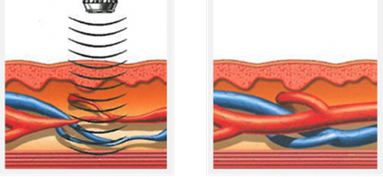
How it works inside the tissue
Calming overactive scar cells
Shockwave regulates fibroblasts, the cells that overproduce dense, inflexible collagen.
Switching off scar-hardening signals
It reduces TGF-β1 and related markers (alpha-SMA and collagen I) that drive excessive scar hardening.
Growing new blood vessels
It stimulates VEGF and new blood vessel formation, restoring circulation and oxygen to poorly supplied tissue.
Remodelling the scar
It activates enzymes called MMPs that break down rigid, disorganised collagen and help restore elasticity.
Is Surgery the Answer?
For some men, surgery is the right choice, particularly where severe erectile dysfunction means a penile implant is needed. But surgery is invasive, often irreversible, and carries risks including infection, loss of sensation, penile shortening and further scarring.
NHS waiting times for a specialist consultation and surgery can also run into years. Many men tell us they would rather explore every non-invasive option first.
We know it is sensible to try a combined, non-surgical treatment plan before committing to surgery. If Mr Wood feels surgery would serve you better, he will tell you honestly and help you understand your options with Senior Professors of Urology which he will refer you to.

Getting Your Life Back, Not Just Your Erection
Peyronie’s Disease can be deeply hurtful and emotionally consuming. Research shows that around half of men with the condition experience depressive symptoms. Many men describe feelings of embarrassment, failure and anxiety, and anxiety itself is a major cause of erectile difficulties.
You may recognise some of these feelings:
- avoiding intimacy for fear it will be painful or unsuccessful
- worrying about your partner’s reaction
- losing confidence and spontaneity
- finding it hard to talk openly about what is happening
- grieving for the sex life you used to enjoy
At Peyronie’s Treatment UK, we treat the whole man. Mr Wood’s experience extends to psychosomatic illness, so your emotional wellbeing is part of your treatment plan from day one, and we can work alongside other professionals supporting you.
For most of our patients, success means more than a straighter penis. It means feeling like yourself again, and rebuilding the confidence and closeness that Peyronie’s took away.
Take the First Step Today
Don’t suffer in silence, and don’t waste one more day. Call our Senior Specialist Consultant, Mr A. Wood, for a free and private initial consultation by phone or at our clinic in York. He will assess your symptoms, explain your options and tell you honestly what results you can expect.
If Mr Wood is busy, simply leave your name and number. When he calls you back, he will not say where he is calling from, to protect your confidentiality.
All calls are Private and Confidential.
Frequently Asked Questions
What results can I expect?
In Mr Wood’s clinical experience, around 97% of men who complete a combined treatment plan see their symptoms resolve fully or improve until they are hardly noticeable. Your own results will depend on your symptoms, their cause and how long you have had them.
Will shockwave on its own fix my Peyronie’s?
No. Shockwave helps soften plaque and scar tissue, but the best results come from combining it with traction and other treatments at the right time.
How many sessions will I need?
Most men start with around 6 weekly sessions. More significant bends may need 6 to 18 weekly sessions alongside other treatments.
Does Peyronie’s Disease go away on its own?
During the active stage, a small number of men see some improvement, but many stay the same or get worse. Once the condition is stable, it rarely resolves without treatment.
Is the treatment painful?
Most men find treatment comfortable and look forward to the results of their treatments. Some notice mild, short-lived tenderness afterwards.
Can you help with the emotional side too?
Yes. Your confidence, wellbeing and relationship are part of your treatment plan, and we included emotional and psychotherapeutic support on your road to a good and full recovery.